Online edition of The Official Newsletter of the Jew's Harp Guild
- The Pluck-n-Post -
|
Contents:A Word from the
Executive Director A Jew's Harp Travelogue II: Bulletin Board Pictorial Archive Saying GoodBye - Des VanDijk Online Newsletter Archive |
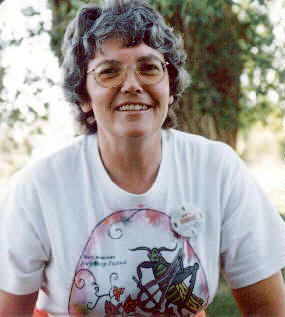 |
 A Word from the Executive Director A Word from the Executive DirectorJanet Gohring — JHG Executive Director |
Hello harpers,
I hope this issue of the Pluck 'N' Post finds each of you twangin' and enjoying summer.
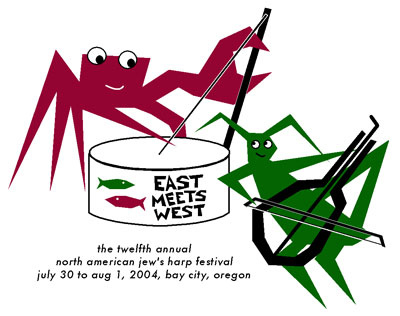
NAJHF 2004: We are in the final stages of preparing for this year's North American Jew's Harp Festival to be held July 30, 31 and August 1 in Bay City, Oregon. You can find festival info at the Guild's website (www.jewsharpguild.org). We have received some very interesting inquiries this year. We expect many of our "regulars" to attend and international guests are always a possibility.
I received an email from Mike Midlo at OPB (Oregon Public Broadcasting). He said, "I noticed that the Jew's Harp Gathering in on the coast this year and thought it would be a good idea to air your ART BEAT story the week before to help promote the event. Your story remains one of my favorites and I hope a repeat will help attract a bunch of folks to the festival. Spread the word: Oregon Art Beat - OPB Television, Thursday, July 22 @ 8:00 pm." Mike and his crew at OPB have done so much to promote the festival and Jew's harp and we are very grateful for their enthusiasm and support. The Art Beat program was very well done so if you haven't seen it (or would like to see it again), be sure to tune in to OPB on July 22nd.
| Our festival organizing committee (Denise Harrington, Curtis Chamberlin
and Gene Ralph) have been busy for months getting everything in place for the best ever
NAJHF. A lot of time and effort go into planning the festival and we are very grateful to
have these talented and dedicated people on our team. Thanks a million! Gordon Frazier has created a very unique T Shirt design and 2004 fest logo. We appreciate his talents and work on this project. Thanks, Gordon! And a great big "thank you" also goes to Gene Ralph for all the energy and effort he has spent coordinating the printing of the shirts. This year's festival will have a less structured schedule than in years past. We hope to have more free time for casual jams and getting to know each other. We will have scheduled "feature performances" during the evenings (advertised for public attendance). |
 |
| Festival Schedule: Open to the public.
All performances are free. Questions? (503) 322-9607 FRIDAY PM: Meet and greet; casual jamming. SATURDAY: Brunch (10 am), Band Scramble (3 pm), Dinner (5 pm). Throughout the day: Jew's Harp Guild info booth .. Open mic performances .. Roaming instructors .. Instrument vendors .. Casual workshops and jams .. Chat with musicians from all over! SUNDAY AM: Breakfast, Winding down and saying farewells. The folks at the Bay City Arts Center will be providing meals on site as indicated in the above schedule. Their food is so wonderful and we appreciate it very much. So, it should be a great time for all and we hope to see YOU there! Take care, have a great summer... and keep twangin' !! Janet Gohring - Executive Director, The Jew's Harp Guild |
|
 |
A Jew’s Harp Travelogue II:
|
| In the fall of 2003 the program I’d been
working for ended, and the severance package allowed me to take some time off. I did the
usual puttering around the house, but also took the opportunity to make a couple of
Jew’s harp related trips, notably one to Europe to visit musician-friends. In the
previous newsletter I told of my trip to Hungary to visit Szilágyi Zoltán; the following
is the story of my visit to Upper Austria. (Note that these articles are not published in
the chronological order of the trip itself: my trip actually began in Austria, then I
visited Hungary, and finally Germany.) First, an encounter while still on the ground in Seattle: As I was getting my carry-on into the overhead compartment, the person sitting across from mine noticed my case. "Hey, are those mouth harps?" he asked. Um, yes, I said, a little surprised. "Like morsings?" he asked. Now I stopped and stared. "You know the word morsing?" I asked, flabbergasted. (Morsing is one of the varieties played in India.) It turns out he is a tabla player; we had a nice discussion. It was a good omen. |
|
| My first stop in Austria was Molln (right), the site of the Second International Trump Congress in 1998, at which I made many friends. One of those friends, Manfred Russman, met me on a blustery evening at the train station in Kirchdorff. The snow was crunchy underneath our feet, the streetlights all had halos, and it was bitterly cold. It was good to be there. | 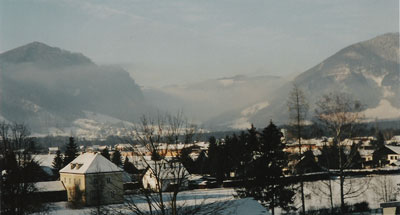 |
| And so away we went…but only for a few blocks, so Manfred could take me to a local restaurant to join a Friday-night stammtisch. This is a weekly meeting of a group of friends at a pub or restaurant or gasthaus, always held at the same time, on the same night, at the same table. (Indeed, some tables have permanent signs hanging over them indicating as much.) It is a time to talk, and drink beer, and talk some more. Once an important part of culture and, I think, politics, they grew less prominent over the years, but have recently seen a resurgence. (I believe the fact that they are now co-ed, instead of the all-male affairs of the past, might have something to do with their return to popularity.) That first night I had the very Upper-Austrian dish of gröstl, a true comfort food with many variations, but always involving potatoes and often sporting a spiegelei (mirror egg) on top. When I told the others at the table that Americans refer to this particular style of egg-frying as "sunny-side-up" they were delighted with the name. The naming of food was just one of many topics we covered that night. Reinie had a spacious apartment in his building where I stayed while in Molln, allowing me to come and go whenever I wanted. It was a good thing; the day after I arrived, to my surprise, I awoke to Reinie and Manfred popping in to see how I was doing. It was not their first attempt. It was 4 o’clock. Yes, p.m. Ah, jetlag. But no matter, I would be in Molln for five days. Plenty of twanging time. For Molln is known to Jew’s harp players everywhere as a centuries-long center of maultrommel production, and even today there are three makers still going strong. One is Schwarz, the largest in terms of units produced. I didn’t get to know any of the Schwarz family on either of my visits. But another large-scale producer of maultrommels is Wimmer, and since I do know Roland I stopped by to pay him and his family a visit. He showed me his collection of harps, and the equipment they use to produce their own. They mass-produce several sizes of one model and make a smaller number of tuned instruments. Roland also showed me a prototype of a version they are planning to produce using a "church-key" style bottle opener. Yes, it still functions as a bottle opener as well. I think we all need one of those! Roland presented me with a Wimmer harp and also a bamboo kubing, then we retired to their living room to watch video from the 1998 congress. All in all, a fine way to spend an afternoon. The third maker in Molln is Jofens-Hörzing. I met maker Joseph Jofens during the 1998 congress, and was happy to renew our acquaintance during this trip. He does not mass-produce maultrommels, but makes each one by hand. While all of the factory-produced Molln harps are playable, Herr Jofens’ handcrafted ones are works of art. I spent several pleasurable hours trying them out, and bought several, including a mid-tone D and a high D. At the time I asked if he had a bass D, but he did not. That would be a difficult one to make, he said. A trip to Molln would not be complete, for me, without a visit to the Steiner-Krudl gasthaus, where the Americans stayed in 1998, so Manfred arranged with the proprietress Heidi to have a knudl night. Knudl is a dish consisting of various types of ground meat and spices wrapped in dough. Heidi is famous for her version, and her fame is well-deserved; they were delicious. (My favorite: hashenknudl, a mixed meat and onion filling, kind of like…well, hash.) They were served with warm sauerkraut seasoned with caraway seeds and to-die-for potato salad. And yes, I could talk about food all day long. But back to Jew’s harping. At one point in the evening, Joseph came over to the table and handed me a maultrommel. He had made it earlier in the day; it was of course a bass D. I was mightily impressed by the effort, and the gesture, not to mention the instrument itself. It sounds lovely, and is now one of my favorites. Once Robert Russmann (he and Manfred are brothers) came inside after a spirited game of curling, we had a mini-concert. I had my recording equipment with me but did not get around to setting it up. Just as well; I believe that the best music is often that which does not get recorded, and it was true that evening. One combination, with Manfred on clarinet, Robert on tuba, and myself on a bamboo kubing, was especially fun—kind of bluesy, kind of funky, kind of indescribable. The next day Heinz, another congress friend, gave me a tour of some of the surrounding area, including stops at a couple of farmhouses where we sampled the local most (hard apple cider) and a little homemade schnapps. (We also had a schnapps tasting at Heinz house earlier that week; Helga’s homemade orange-flavored schnapps was the highlight. Their daughter Angie was there too—at the congress she was a teenager and served as our informal interpreter and cultural guide; this trip she introduced me to her fiancé. Has it really been that long since I had been there?) Heinz also, at my request, took me to the nearby hamlet of Georgiberg, where there is a little church with (they say, and I believe it) the best acoustics in Upper Austria. Micheldorf Georgiberg is built atop a stone alter, visible through a hole in the floor behind the pulpit; someone has worshipped something on that spot for millennia. It is an amazing spot, if hard to get to that day—the snow was deep, and the road to the top of the hill was impassable, so we had to hike in. I recorded lots of music in that incredible soundspace, trying different instruments, playing along to the blizzard raging outside. When I was done we went down and called from a farmhouse for a tractor, to pull Heinz’s car from the drift where it had gotten stuck. Yep, it was an experience. Another notable experience were the presentations I did a couple days later for Folksschule Molln, the local grade school. Manfred’s mother-in-law Traudi was, until recently, the principal of the school, and it was she who set it up. The children (ages 6-10) came in two groups, each about 60-70 strong They were excited, but attentively polite once I began. I demonstrated instruments from Hawaii, the Philippines, China, and Siberia, as well as the more familiar ones (to them) from Germany, Hungary, Austria, and the United States. They had many questions: How did you learn to play like that? (Practice); How many do you own? (Around 135); What is Seattle like? (It’s on the water, and we get no snow). They were a kick. Afterwards I went to Traudi’s house where I sampled her version of gröstl (potatoes, onions, cheese, herbs…yum!), met her husband France, and got to visit with the two of them as well as Manfred and his wife Magdelena. |
|
 Annette Wurz on the overtone flute |
Regretfully leaving Molln behind, I accepted Traudi’s
gracious offer of a ride to the next stop on my Austrian itinerary, a small town on
Attersee Lake where I visited my friend Annette Wurz for a few days. I met Annette by
being part of a dance-music improvisation group she organized at the 1998 congress. I had
quite a lot of fun there, playing in the snow and going sledding with her and her two
children Dorian and Diana Aurelia, and listening to her play haunting melodies on the
overtone flute. We went to Salzburg one day so I could visit Gerald Mertens, who was also part of the improv group. Gerald plays many types of percussion and other instruments. He and I spent the day in his tiny apartment playing music; when it got dark we met Annette and her kids for Chinese food. We joked about the fact that Salzburg is a big tourist destination, but I took part in no tourist activities. |
| That thought occurred to me again a couple days
later as I was on the train to Hungary. My train would go through Vienna, then I would
switch trains in Budapest—both exceedingly popular cities with world travelers, yet I
would be passing them by. For I was visiting the world of the Jew’s harp, and that is not the world of the tourist brochure. It is a world of out-of-the-way places, of small towns, cozy guesthouses, late-night jams, and the homes of friends. It is a world without borders. It’s a good place to be. Next stop: Hildesheim, Germany. |
|
POST YOUR NOTES
- I'm a 77 year old woman whose father left her a Jews Harp. I have given it to my son and would like him to have a movie that was made several years ago with the background music which was all done by a Jews Harp. I believe it was "Stagecoach", and I ordered the first one made, but it doesn't have that music. Can you help me? I want him to have the movie to go with the harp.
Dorothy Gay DotBobGay@aol.com
- Just wanted to say thanks for the great lesson by Wayland Harman. It was very CLEAR and SIMPLE and had me playing my jews harp (that I've been twiddling with for weeks now) better in a few minutes.
Seth Olinsky setholinsky@hotmail.com
- Just found you a couple nights ago. I've made and played bamboo jew's harps for over 32 yrs. And hadn't met any players till [I met] Larry Hanks a couple of weeks ago at the "Wild Iris Folk Festival". He turned me on to you! I love your site! Its opened a whole new world to me. Thank you! Hope to see you at the festival. I also play spoons & a little dulcimer & harmonica.
Ralph Christensen rcsiningbamboo@aol.com
- I am directing a western play and would like to gain access to recordings of western music, circa 1860-1900 played on harmonica or jews harp. I wonder if you can help me. Many thanks.
Dougie Squires dougiedirect@btinternet.com
- Hi. I'm living in Sete (south of France) and I'm very interested about jew's harps. Above all, I would like to buy some in aluminum (one like done by Andrea Bugari). Can you send me some information? By advance thank you. Jean Marie Pons jean_mariepons@hotmail.com
- I have learned a lot about playing technique, the history and different traditions of the jew's harp from the website of the Jew's Harp Guild since I started looking for information on the www in 2000. Also, the photographs of the festivals are interesting and enjoyable. And there is a lot to be learned from the sound examples, too. However, I think a comprehensive Article about playing techniques and their background is missing. So I have written such an article, describing different playing techniques. I illustrated the descriptions with graphics and sound examples and added paragraphs about the theory of the instrument. It is published at http://home.bnbt.de/r.vandre . Now I need feedback. There is a lot of good material on the jew's harp on the www, but nevertheless I think my description contributes something - of course the article could be improved a lot and futher developed. This is why I am writing to the Jew's Harp Guild. Maybe somebody looks at the article and helps improving it. I am keep to continue working on the project. (The project is strictly non-profit, just for the fun of the instrument). Thank you very much, with best regards to all friends of the Jew's harp.
Robert Vandre - robert.vandre@epost.de
INTERNATIONAL JEW'S HARP SOCIETY NEWS:
We just received the first (No. 1 / 2004) issue of the JOURNAL OF THE INTERNATIONAL JEW'S HARP SOCIETY, edited by Fred Crane. The first half of the journal includes articles on: Production of Trumps in Italy, the Trump in German Prose Literature, Book Reviews, Recordings of the Trump in Argentina and Chile, Troll and Trumps: An Update, Trumping in Commercial Recordings of the 78 rpm Era, Proceedings in the Old Bailey 1729 ... all interspersed with drawings from America's Wayland Harman (NAJHF "MC" for many years and inventor of the Clackamore). The journals' second half is dedicated to a "Rauland Portfolio" (of the 4th International Congress/Festival in Rauland, Norway).
There are many pages of wonderful color photos ... enough to make you feel like you were actually there (how sorry we were not to be able to attend) ... followed by five of the papers presented at the Congress: Jew's Harps in European Archaeology, Temir-Komuz from the Motherland of Manas and Chingiz Aitmatov, The Music of the Yakut Traditional Khomus, The Jew's Harp Music Culture in the Atayal Ethnic Group Among the Taiwan Indigenous People, and Argentina in the Trompd's World.
If you'd like your own copy (and you should!!), you can contact: Fred Crane at 601 N. White Street, Mt. Pleasant, IA 52641 for all the details.
| Earlier this year, we lost our long time Dutch friend and
Jew's harper, Des VanDijk. Des lived in Amsterdam and bravely fought a long bout with
cancer. We first met Des at the 2nd Sumpter Valley Jew's Harp Festival. She was in the USA visiting her friend Ingrid Berkhout, both excellent female Jew's harpists. They were intrigued by our festival advertisements and made a special trip from Seattle to attend. We always teased Des about being the only "casualty" in our festival history ... she fell at one of the local restaurants and broke her arm! Over the years, we became very good friends with Des. She attended two NAJHF, treating us both times with her rhythmic and accomplished Jew's harp techniques ... and her warm and wonderful personality. Des was a very fine percussionist, always impressing us with her unique playing style. |
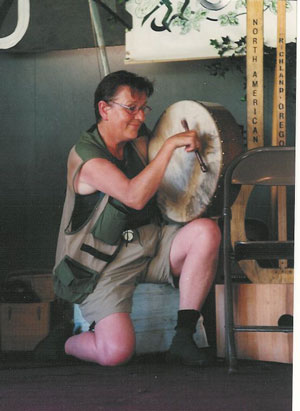 Des VanDijk at the NAJHF |
| When Bill and I attended the 3rd International
Jew's Harp Congress in Molln, Austria, our final stop-over before returning home was a
splendid week in Amsterdam with Des. Our first night there, she invited us to be her
special guests on the weekly radio program she hosted. She was the perfect hostess during
that week, touring and dining and exposing us to all the sights and sounds of that
wonderful city. Her apartment was crammed with all sorts of drums and percussion
instruments from all over the world ... and, of course, lots of Jew's harps. Des was very active in the Humanist movement and her diligent work over the years helped women all over the world achieve independence and security. She often traveled to undeveloped countries to assist needy women with hands-on expertise. She was a very caring person and her love of humanity shone in her every movement. She titled her CD "peace, joy and love" and she certainly shared those things wherever she went. I feel so privileged to have had the honor of knowing and loving her ... she will certainly be missed. Janet Gohring |
|
|
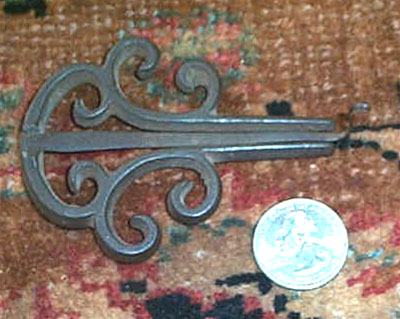
I've recently aquired an early jews
harp with some old civil war paperwork. I was wondering if you might be able to help me
acertain if it is indeed as old as the artifacts it came with. I've run across a few harps
in the past, but never one quite as fancy as this one. Any help would be
greatly appreciated. Thanks, Rick Hunt |
The PLUCK-N-POST needs more contributors!
If you have ideas for articles, sketches, or pictures, etc. Please query the editor at:
PLUCK-N-POST
Mark Poss
924 10th. Ave. N.
Nampa, ID. 83687
Compact Disc - DBS-2707 - Total Time : 61:47
US$12.00 each + US$ 3.00 S & H in USA (US$ 5.00 international).
Send check or money order to:
The Jew’s Harp Guild
c/o Ralph Christensen
2239 Fairfield Street
Eureka, CA 95501
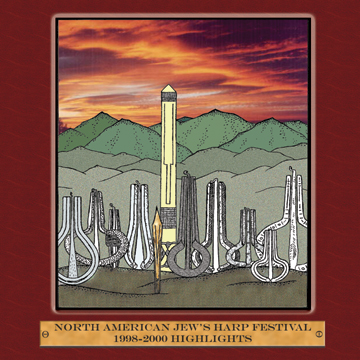 |
Summary:Highlights 1998 - 2000 There’s nothing else like the
|
See the JHG STORE for makers, sellers. publications & jhg products
| North American Jew's Harp Festival 1997 Highlights CD The CD features 20 of the
best Public Domain, spontaneous music, There are only a few left! US $12.00 each International - 1 item US$ 5.00
|
Original
Art Blank note cards w/envelopes 39995 Sumpter Valley Hwy. |
|